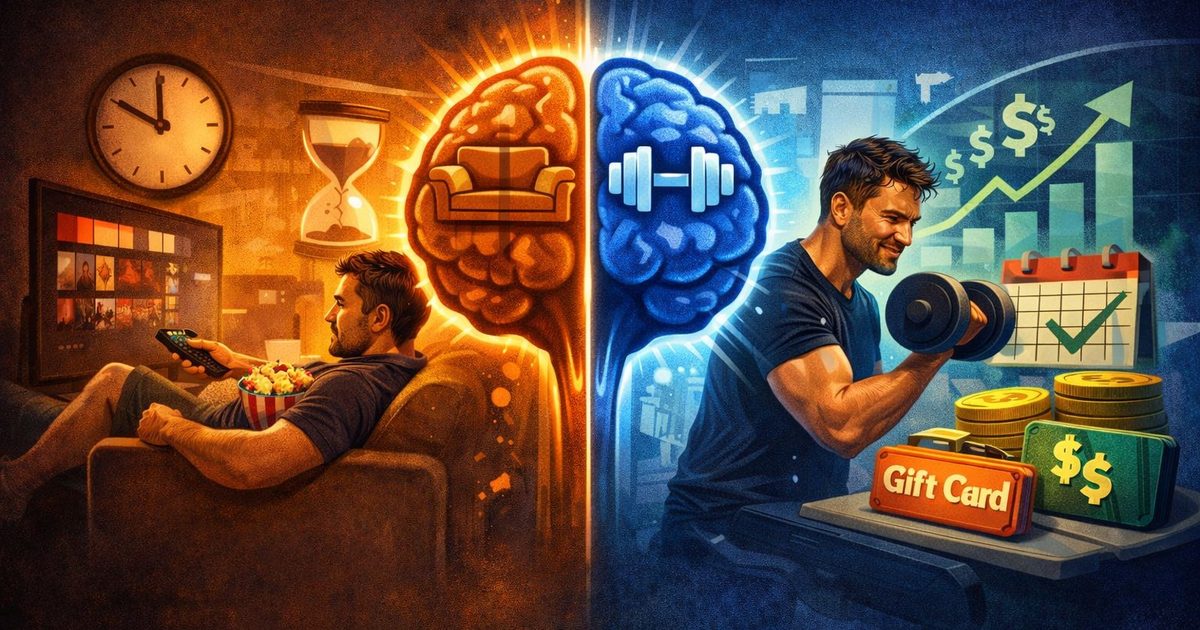
Imagine you're deciding whether to go to the gym after a long day at work. You know you should go. You want to be healthier. The rational choice is clear. And yet, you don't go.
This isn't a failure of knowledge. It isn't even a failure of desire. It's a predictable outcome of how human decision-making actually works. And once you understand that, you can stop blaming yourself and start designing better systems.
What Behavioral Economics Actually Is
Behavioral economics blends insights from psychology with traditional economic theory to understand how people actually make decisions, especially when they deviate from what is considered "rational." Unlike classical economics, which assumes individuals always make logical, self-interested choices, behavioral economics recognizes that people often act in ways that are emotional, impulsive, and heavily influenced by context.
In other words: we are often irrational. Not occasionally but predictably, consistently, and measurably irrational.
Three of the most important cognitive biases:
- Loss aversion: We fear losing something roughly twice as much as we enjoy gaining the equivalent. Losing $20 hurts more than finding $20 feels good.
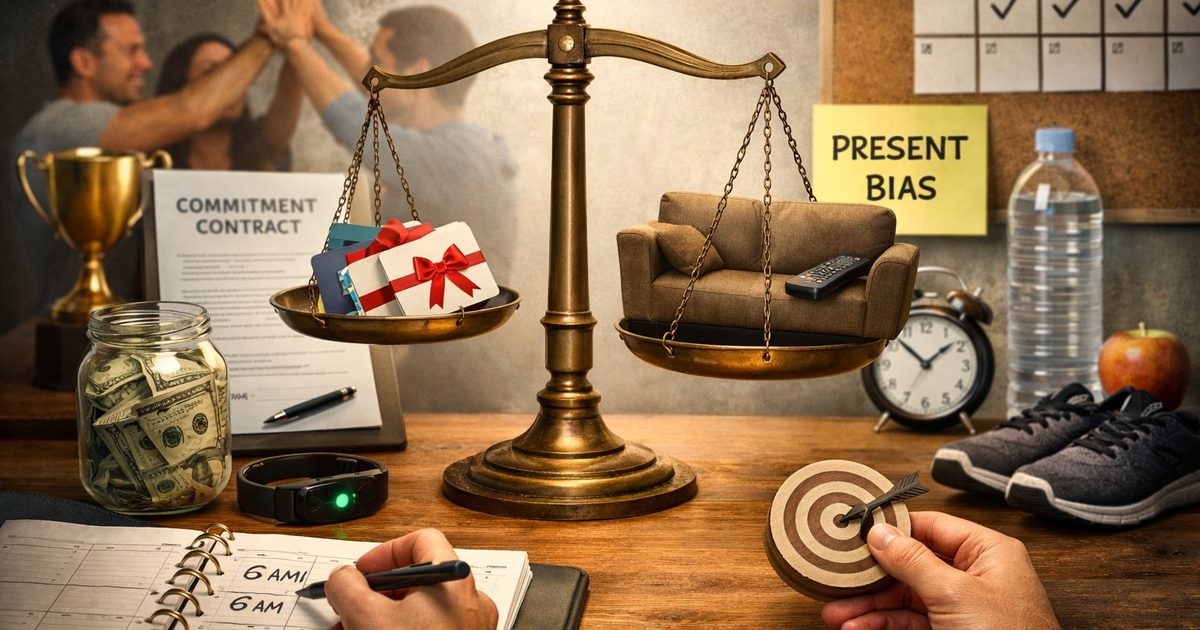
- Present bias: We overvalue immediate rewards relative to future ones. Netflix tonight feels more compelling than better health in six months, even when we genuinely want both.
- Status quo bias: We prefer things to stay the same, even when change would clearly benefit us. Inertia is a powerful force.
These biases explain why we procrastinate, overspend, struggle to save for retirement, and - critically - struggle to build consistent exercise habits.
The Power of the Nudge
One of the most powerful contributions of behavioral economics is the concept of nudging. A nudge is a subtle change in how choices are presented, designed to guide people toward better decisions without restricting their freedom.
The classic example: enrolling employees automatically in a 401(k) retirement plan, with the option to opt out, dramatically increases participation. The insight is elegant: you don't need to change what people want. You change the environment in which they make choices, and behavior follows.
Applying It to Your Own Life
To save more money: Set up automatic transfers to savings. This uses inertia in your favor; the default becomes saving, not spending.
To build healthier habits: Reduce friction for behaviors you want more of (lay your gym clothes out the night before). Increase friction for behaviors you want less of (remove junk food from the house). PayBack Fitness adds an additional lever: real financial stakes (PF Points worth $1 each, redeemable as gift cards) that make showing up the obviously better choice in the moment.
To avoid impulse spending: Implement a 24-hour cooling-off rule before non-essential purchases. This counteracts present bias by inserting a delay between impulse and action.
"The goal isn't to want it more. The goal is to design an environment where the right choice is easier than the wrong one."
The Bottom Line
Behavioral economics provides a practical roadmap for designing a life where better decisions are easier to make. It encourages you to become the architect of your own environment - structuring your choices to reduce friction, increase motivation, and gently push yourself toward the outcomes you actually want.
PayBack Fitness harnesses loss aversion, immediate rewards, social accountability, and commitment contracts - the most evidence-based tools behavioral economics has to offer - to help you do one specific thing: show up consistently. Because your health deserves a system that works, not just intentions that fade.
Put behavioral economics to work for your fitness. Join a Block and experience the difference a well-designed system makes.
Join PayBack Fitness →