You already know that exercise pays off: a stronger body, more energy, a longer and healthier life. The long-term case is airtight. And yet, many of us still skip the gym to watch Netflix.
Is this irrational? Absolutely. Is it predictable? Also absolutely. Behavioral economics has a name for it: present bias.
The Science of Why We Skip
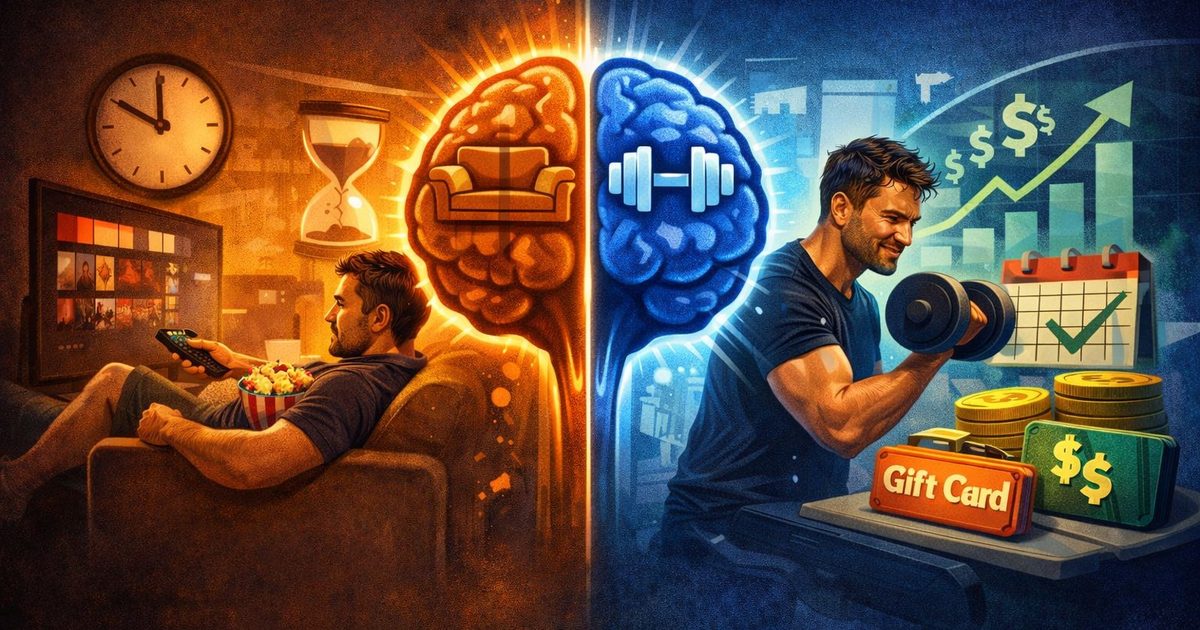
Present bias describes our tendency to give disproportionate weight to immediate rewards and costs relative to future ones. The discomfort of tonight's workout feels very real, very now. The health benefits six months from now feel abstract and distant. Our brains aren't wired to treat these equally... and so the couch wins, again and again. (Laibson, 1997)
This effect is compounded by temporal discounting - our tendency to devalue rewards the further away they are in the future. (Frederick, Loewenstein, & O'Donoghue, 2002) A $10 reward today feels more valuable than a $20 reward a month from now. Applied to fitness, this means we routinely sacrifice long-term health for short-term comfort - not because we're weak, but because that's how human cognition is structured.
"People don't often respond to logic. We respond to how choices are structured. PayBack Fitness is built around that reality."
Why Delayed Gratification Is So Hard
- We tend to overvalue immediate comfort: skipping the gym, sleeping in, choosing the couch
- We tend to undervalue long-term payoffs: better health, more energy, longer life
- The result is inconsistency, broken habits, and stalled progress
This isn't a character flaw. It's a feature of how human decision-making evolved. Our ancestors didn't survive by optimizing for 30-year outcomes; they survived by responding to immediate threats and rewards. That wiring served us well then. In modern life, it works against us.
The Power of Bringing Rewards Closer
Behavioral economics offers a practical solution: if you want to change behavior, bring some of the reward closer to the present. This is the principle behind nudges - small, immediate signals that make the better choice more appealing right now. (Thaler & Sunstein, 2008)
How PayBack Fitness Bridges the Gap
Short-Term Rewards for Consistency
Instead of waiting months for visible results, you earn PF Points weekly (each worth $1, redeemable as gift cards from 200+ brands) by hitting your workout goals. This directly combats temporal discounting by making the payoff immediate and tangible.
Making Progress Visible
PF Points accumulate like a savings account, giving you a concrete, visible record of what small consistent actions compound into. This reframes delayed gratification as an ongoing, visible process rather than a distant abstraction.
Leveraging Loss Aversion
If you miss your weekly goal, your forfeited PF Points are redistributed to others who stayed on track. This taps directly into loss aversion; people hate losing something they already have far more than they enjoy gaining the equivalent. (Kahneman & Tversky, 1979) It also creates community accountability, making workouts a shared commitment.
The Big Takeaway
Present bias and temporal discounting explain why we struggle with consistency. It's not because we don't care, but because the incentives around exercise are poorly designed for how our brains actually work.
By combining immediate rewards (PF Points, weekly), long-term payoff (better health, lasting habits), and real consequences (loss aversion), PayBack Fitness makes it easier to stay on track. It's not just motivation. It's architecture.
Your brain is working against you. PayBack Fitness gives it a reason to work for you instead.
Join PayBack Fitness →