It started with a simple question: How do I motivate myself to get in better shape?
If you're like most people, you've asked yourself some version of that question more than once. And yet the cycle keeps repeating: a burst of motivation, a brief stretch of consistency, then something changes (work gets busy, stress spikes, routines break, travel happens) and the behavior slips. We tell ourselves we'll "get back to it," and sometimes we do. Often we don't, at least not for long.
So what gives? Here's the hard truth: even good habits fade when the system that supports them disappears. And once you see that, the path forward becomes clearer.
The Promise We Are All Sold
We're often told that once a habit is built, it sticks as if you've "unlocked" a new version of yourself. Books like Atomic Habits have helped millions take meaningful steps in that direction. The core message is valuable: small changes compound, identity matters, and environment often beats willpower.
But my experience building PayBack Fitness has exposed a limitation that rarely gets discussed.
About three years ago, I built the foundation of what is now PayBack Fitness: a simple fitness competition designed to harness behavioral economics to increase workout consistency. It worked... and it worked extremely well. Over time, as the dataset grew (nearly 5,000 workouts logged across multiple groups), a pattern became impossible to ignore:
"Habits fade. Systems matter."
The Uncomfortable Pattern I Keep Seeing
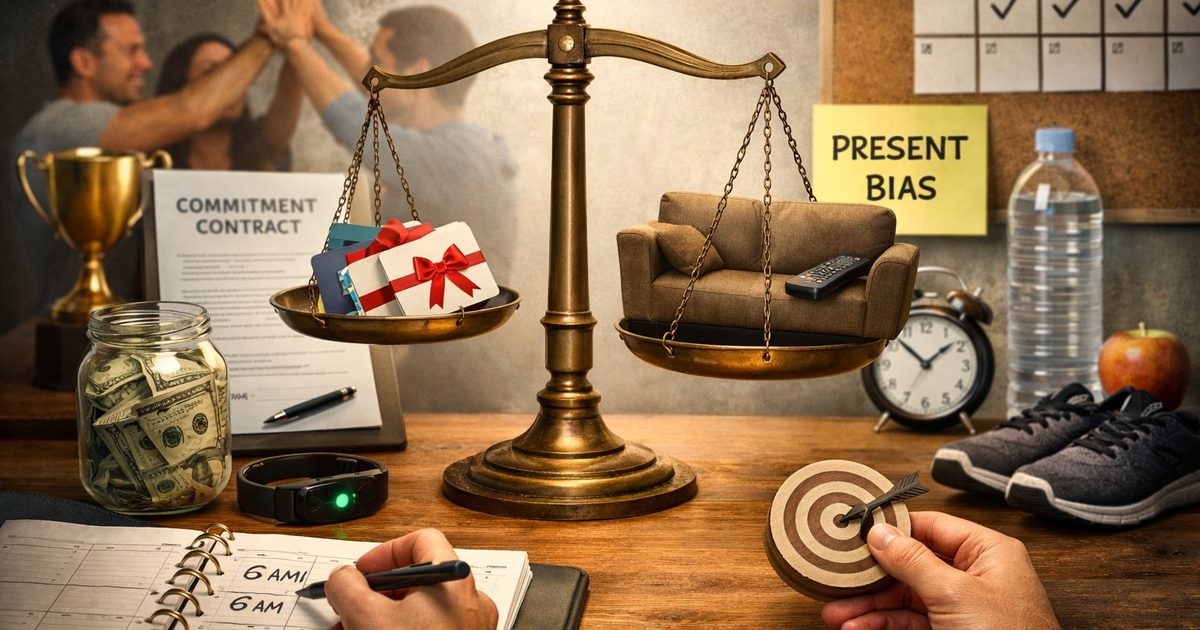
When people have real stakes on the line, specifically, PF Points (each worth $1, redeemable as gift cards from 200+ brands), workout consistency improves dramatically. In my groups, most participants reported a nearly five-fold increase in workout frequency after joining. Win or lose, the behavior changed. Better routines formed, often within days.
But here is the uncomfortable part: building the habit wasn't enough to make it permanent.
Over the years, some participants stepped away from the competition for perfectly normal reasons: pregnancy, a new child, travel, family demands, injury... Life. And when enough time passed without the competition, many of them reported that their workout frequency dropped sharply, falling back toward their default levels.
Then they would rejoin. And their consistency would rebound again, often within days.
That raises the question at the center of this entire post: if someone had been consistent for ten weeks, often much longer, and clearly "built the habit," why did the habit erode once the competition disappeared? And why did it return so quickly when the system returned?
This Isn't Failure. It's Human Behavior.
Habits are not trophies you earn once and keep forever. They are patterns that become likely under certain conditions, and less likely when those conditions change. When structure disappears, friction returns. When accountability fades, shortcuts become easier. When short-term consequences vanish, long-term goals lose urgency.
Research supports this: changing behavior is an inherently unstable process, with frequent lapses and relapses expected to occur, especially as context and cues shift. (Kwasnicka et al., 2016)
You can see this in almost any domain. Want to quit smoking? Success rates improve dramatically when you change your environment and remove cues; but return to familiar triggers and the old pattern often resurfaces. That's not a character flaw; it's conditioning. The behavior didn't "break." The context that made it effortless changed.
The Missing Assumption in Habit Books
Most popular habit literature assumes a kind of psychological continuity that doesn't reflect the messy reality of human life: stable environments, constant identity, motivation permanence. Real life rarely offers any of these. People move. Work changes. Relationships evolve. Health fluctuates. Seasons shift.
When context changes, the cues that once triggered a habit weaken or disappear, making the behavior less automatic and more effortful. This is consistent with research showing that habit activation is cue-dependent and that changing context can disrupt even previously strong habits. (Wood & Neal, 2007)
That's not to say the science of habit formation is wrong. It's just incomplete. It tells us how habits form, but says much less about how they persist when context changes.
A Better Mental Model: Habits as Subscriptions
"Habits are subscriptions, not achievements. A subscription needs renewal. It needs structure. It needs a reason to stay active. Without that, it expires."
- Habit strength depends on cues and consistent reinforcement
- Identity alone doesn't guarantee behavior when context changes
- Structure reduces friction and keeps cues aligned with the desired behavior
- Recommitment isn't failure; it signals commitment against changing circumstances
Willpower without structure is weak. Structure without recommitment is transient. Both are necessary.
What This Means for Fitness
If you've ever said to yourself "I fell off the wagon," take heart. It isn't moral failure. It's contextual drift - a normal part of how human behavior works.
Systems like PayBack Fitness don't deny that habits can form. They embrace the reality that habit strength waxes and wanes, and create a mechanism to bring people back into productive structure whenever life pulls them out.
In PayBack Fitness, the mechanism is concrete: each new Block is a fresh commitment. A new set of stakes (real PF Points, each worth $1) on the line each week. A new group of people counting on each other. A renewed context that makes showing up the obvious choice. Rejoining a Block after a gap isn't failure. It's exactly the system working as designed.
The Reframe That Changes Everything
The goal isn't to build a habit once. It's to create a system you're willing to rejoin again and again. Good habits are powerful, but only when they're supported by systems that can survive life's inevitable changes. Structure isn't a crutch. It's the foundation that makes behavior possible when motivation isn't enough.
Ready to build the kind of consistency that survives real life? Join a Block and put a system behind your habits.
Start Your First Block →