Most people picture frailty as something that arrives in their late 70s or 80s. A slower walk. A hand on the railing. Trouble getting up from a low chair.
But a growing body of research suggests the biology behind frailty starts shifting much earlier, potentially decades before anything looks or feels different.
A recent National Geographic article pulled together several of these studies, and the picture they paint is clear: midlife is not too early to think about staying strong. It may be the best time.
The good news is that exercise is the most effective tool we have for changing that course. The challenge, as always, is doing it consistently.
Aging Doesn't Happen All at Once
We tend to think of aging as a smooth, steady slope. The research increasingly says otherwise. Some biological changes appear to arrive in clusters.
A 2026 study in Cell Metabolism analyzed nearly 3,000 blood proteins in 50,506 adults from the UK Biobank and found that proteins associated with frailty changed in two waves, peaking around age 50 and again around age 63.1
Around 50, the changes clustered in proteins tied to energy metabolism and hormone activity. Around 63, they shifted toward inflammation and immune function.
None of this means you wake up weaker on your 50th birthday. It means the processes that eventually produce frailty appear to accelerate during particular stretches of adulthood, and the first of those stretches comes earlier than most of us assume. It also means the decade before 50 is when getting ahead of it pays off most.
Measurable declines in muscle strength and power can begin earlier still. Experts quoted in the National Geographic piece put the start as early as the late 30s, with losses accelerating later.2
As a neurologist, some of the most common pathologies I see affect movement and strength. Long before anyone mentions weakness, the neurologic exam begins the moment I walk in the room, paying attention to the small things: how quickly a patient gets up or sits up, how steady and symmetric their movements are, how well they communicate, and so much more. Gait speed and the ability to stand from a chair are two of the most useful signs of physical reserve we have, and they are not things patients typically bring up on their own.
By the time stairs feel harder or carrying groceries takes planning, the underlying changes have usually been building for years. That is the part worth sitting with. The window to act is widest when nothing feels wrong yet.
How Much Can Exercise Actually Help?
The evidence here is strong, and it is worth being precise about what it does and does not show.
A 2024 systematic review and network meta-analysis in European Geriatric Medicine pooled nine randomized trials involving 842 adults aged 60 and older who were robust or pre-frail at the start.3 Exercise-based interventions were associated with a 74 percent lower relative risk of developing frailty compared with control groups. Nutrition on its own showed no statistically significant benefit.
Read that again. In these trials, improving nutrition without adding exercise did not measurably lower anyone's risk of becoming frail. Eating well matters for plenty of other reasons, but when it comes to staying strong, diet is not a substitute for movement.
Those participants were all over 60, so the figure should not be read as a precise estimate for someone starting in their 40s or 50s. The authors also flagged the limits of the available trials.
For the midlife question specifically, a separate 2024 systematic review in Preventive Medicine looked at eight intervention studies involving 2,838 adults aged 40 to 65.4 Resistance training and multicomponent exercise showed the most promising evidence to date for preventing or reversing pre-frailty and frailty.*
There is also evidence that early frailty is not a one-way street. A 2026 analysis in Maturitas followed 3,405 adults aged 50 to 64 in the English Longitudinal Study of Ageing and found that moderate and vigorous physical activity were associated with moving from frailty back toward pre-frailty.5
"Physical decline in midlife is not a verdict. On the evidence, it is closer to a trend line, and exercise is the most reliable way to bend it."
Is Walking Enough?
Walking is the most accessible exercise there is, and more daily steps bring real cardiovascular and metabolic benefits. But when the goal is preserving physical function into older age, walking is only part of the equation.
A 2024 meta-analysis in Experimental Gerontology pooled 28 randomized controlled trials involving 4,857 frail adults aged 60 and over.6 Multicomponent exercise programs, meaning programs that combine several types of training, improved:
- Frailty status, the overall measure of physical vulnerability.
- Muscle strength, the capacity to generate force for everyday tasks.
- Walking speed, one of the best single indicators of mobility and functional health.
- Balance, a core component of fall prevention.
- Physical function, on standardized tests such as the Short Physical Performance Battery and the Timed Up and Go.
A second 2024 meta-analysis in BMC Geriatrics, pooling 18 trials and 3,457 community-dwelling older adults, found multicomponent exercise cut the risk of physical frailty by roughly 41 percent regardless of program length or format.7
The lesson is that being active and being comprehensively fit are related but not identical. Someone can hit 10,000 steps every day and still rarely load their muscles. They get real benefits from the walking, but they leave strength and power on the table, and those are the qualities that matter most for staying independent.
The federal Physical Activity Guidelines reflect this: at least 150 minutes of moderate aerobic activity per week, plus muscle-strengthening activity on at least two days.8 Aerobic work, resistance training, and balance training each protect a different part of the system.
Does Your Fitness App Measure What Matters?
This distinction matters when you choose how to track and motivate yourself.
Step-based accountability apps such as StepBet and Steppa are built around daily step goals, and for the goal of moving more during the day they work well. I said as much in our comparison of six apps that pay you to work out, and I stand by it.
But steps don't capture a strength session, a swim, a bike ride, or balance work. Someone who finishes a hard 45 minutes with a barbell may register fewer steps than someone who wandered a shopping mall. The step counter cannot tell the difference. Your body can.
PayBack Fitness is built around a different unit: the workout itself. Each group's goal is a number of workouts per week and a minimum duration per session. Lift, run, swim, cycle, do a balance class, or mix them. If it's dedicated physical activity that meets the minimum, it counts. That makes it possible to build accountability around the well-rounded routine the research points to rather than around a single metric.
To be clear, no research shows one app is clinically superior to another. The research argues for incorporating several kinds of exercise. The app's job is to help you keep showing up for them.
Why Knowing Isn't Enough
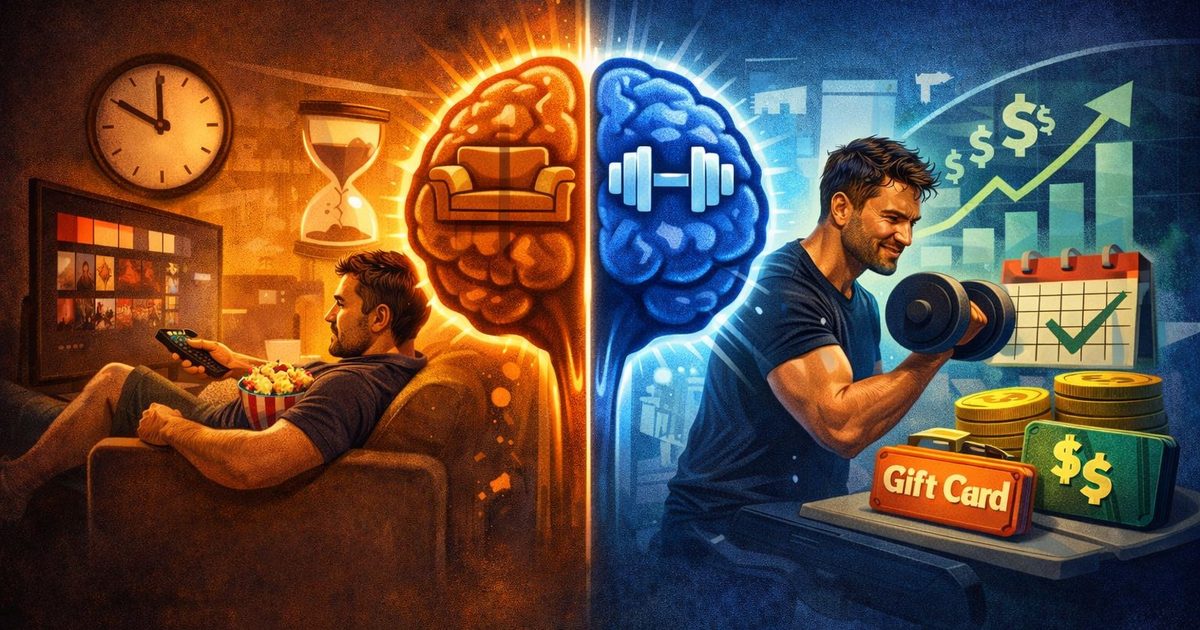
Here is the obvious problem. Knowing that today's workout protects the strength you'll need at 80 does almost nothing to get you off the couch tonight.
Behavioral economists call this present bias: we value immediate rewards far more than distant ones. The cost of a workout is paid now. Its biggest payoff might arrive in 30 years. That mismatch is why information alone so rarely changes behavior, and why one skipped session so easily becomes a skipped month. I've written about this in more depth in Delayed vs. Instant Gratification.
The same field offers a way out. Loss aversion, the finding that losing something stings far more than gaining the same amount feels good, means that money already committed is a stronger motivator than money you might earn. Put something at stake today, and the long-term benefit suddenly has a short-term ally. Financial incentives don't work for everyone and their design matters, but they directly address the gap between intention and action.
How PayBack Fitness Turns Long-Term Goals Into Short-Term Motivation
PayBack Fitness was built around a simple question: what if the immediate incentives for exercise were better aligned with its long-term benefits?
It runs in 10-week competitions called Blocks. To enter a Block, you commit 100 PF Points, worth $100 in gift card value, and join a group with a weekly goal: a set number of workouts, each meeting a minimum duration. You can create a group and set that goal yourself, or join an open group whose goal already fits your life.
Each week you hit your goal, you earn at least 10 PF Points back, and more when other members of your group miss theirs. Miss your goal, and your 10 PF Points for that week go to the members who showed up. If nobody in the group hits the goal, PayBack Fitness credits everyone 10 PF Points anyway. We don't profit when groups fail.
For someone in their 50s focused on strength and mobility, a group goal of four workouts a week at 30 minutes each, mixing resistance training and aerobic work, is a reasonable target. For someone just getting started, three sessions of 15 to 20 minutes is a better place to begin. The specific goal matters. Sustaining it for ten weeks, and then the next ten, matters more.
Financial stakes are not a substitute for medical guidance, and PayBack Fitness has not been clinically studied as a way to prevent frailty. It solves a different, closely related problem: helping people consistently do the exercise they already know they should be doing.
The Midlife Workout Window Is Open Right Now
The emerging science of aging offers a warning and an opportunity. The warning is that the changes leading to frailty begin long before we think of ourselves as old. The opportunity is that regular, well-rounded exercise can change that trajectory, and the window for doing so is open right now.
You don't have to wait until 40 to take advantage of it. And if you're already past 50, or 63, the research says it is not too late to begin.
The question that matters isn't whether you understand the benefits of exercise. It's whether you've built a system that makes you follow through.
The benefits may be decades away. The motivation doesn't have to be.
Ready to make your workouts consistent? See how a 10-week Block works.
How PayBack Fitness Works →